
 English


A technical procurement guide to Hohmann bone retractors and bone levers, analyzing blade widths from 8mm to 70mm, curved vs 90-degree bend profiles, fulcrum lever mechanics, and ASTM F899-certified stainless steel sourcing.
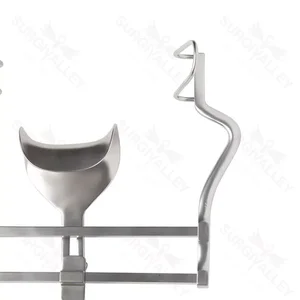
In orthopedic trauma, total joint arthroplasty, and pelvic reconstruction, the Hohmann retractor functions not merely as a passive soft-tissue barrier, but as a rigid mechanical lever. Originally refined to expose the femoral shaft and acetabular margin without stripping collateral periosteal vasculature, the instrument relies on a curved blade that hooks around bony contours while the tapered handle transfers leverage to the surgeon's hand. For institutional procurement officers and orthopedic hospital buyers, selecting Hohmann retractors requires evaluating blade profile width, tip curvature geometry, tensile rigidity under lever load, and vacuum heat treatment to prevent intraoperative deflection or micro-fracture.
1. Functional Anatomy and Mechanical Leverage Principles
The operational effectiveness of a Hohmann bone retractor depends on the ratio between its load arm (the distance from the fulcrum resting on cortical bone to the retractor tip) and its effort arm (the shank and handle length). When retracting heavy quadriceps or gluteal muscle mass, inadequate blade thickness creates torsional deflection, leading to sudden slip and soft tissue tearing.
| Hohmann Variation | Blade Width | Tip Geometry | Overall Length | Primary Clinical Indication |
|---|---|---|---|---|
| Mini-Hohmann | 6 mm – 8 mm | Pointed or rounded beak | 160 mm – 180 mm | Hand, wrist, foot, and ankle osteotomies; delicate metatarsal exposure. |
| Standard Narrow Hohmann | 10 mm – 18 mm | Short blunt beak | 220 mm – 240 mm | Long bone diaphysis exposure (radius, ulna, fibula, pediatric femur). |
| Standard Broad Hohmann | 24 mm – 43 mm | Wide curved beak with blunt lip | 240 mm – 280 mm | Adult femoral shaft plating, proximal tibia osteotomy, subtrochanteric fractures. |
| Bent / 90° Hohmann | 18 mm – 35 mm | Right-angle dropped shank | 240 mm – 260 mm | Deep acetabular rim visualization in total hip arthroplasty (THA). |
| Extra-Wide Pelvic Hohmann | 50 mm – 70 mm | Broad flattened spatula tip | 260 mm – 300 mm | Anterior pelvic ring exposure, sacroiliac joint plating, complex acetabular reconstruction. |
2. Metallurgy, Yield Strength and ASTM F899 Calibration
Because the Hohmann retractor is subjected to substantial bending moment during muscle levering, steel composition is critical. Cheap carbon alloys or unhardened ferritic steels bend permanently under 400 N of retraction force. SurgiValley manufactures all Hohmann retractors from premium martensitic surgical stainless steel AISI 420 (DIN EN ISO 7153-1), achieving a Rockwell hardness rating of HRC 48–52 following vacuum heat treatment.
- Tensile Yield Strength: Calibrated to withstand >750 MPa before exhibiting micro-yield, ensuring complete elastic recovery after heavy quadriceps levering.
- Satin Electropolished Surface: Glare-reducing matte finish that minimizes reflections under 100,000-lux OR surgical illuminators while sealing surface grain against micro-pitting.
- Passivation Verification: Full immersion passivation adhering to ASTM A967 Standard Specification for Chemical Passivation Treatments for Stainless Steel Parts, verified via copper sulfate testing to eliminate surface free iron.
3. Critical Inspection Points for Incoming Hospital Consignments
CSSD managers and clinical evaluation committees should enforce a 4-point mechanical verification protocol when auditing new Hohmann consignments:
- Tip Radius Symmetry: Verify that the beak tip has no burrs, sharp machining edges, or asymmetrical grinding that could score the periosteum or lacerate adjacent neurovascular bundles (e.g., femoral nerve or profunda femoris artery).
- Shank-to-Blade Transition: Inspect the structural shoulder where the shaft widens into the blade. This point represents the primary stress concentration zone; it must feature a smooth 3.5mm radius fillet rather than a sharp milled step.
- Handle Grip Ergonomics: Confirm that finger cutouts and thumb rests provide non-slip leverage even when handled with fluid-saturated surgical gloves.
- Autoclave Thermal Stability: Ensure zero warping or dimensional change across validated 134°C (273°F) prevacuum steam sterilization cycles at 2.2 bar pressure.
Related Posts
Oct 28, 2026 by Dr. Rachel Moore