
 English


An evidence-controlled method for comparing established instrument families by documented geometry, mechanism, configuration and inspection criteria.
Established instrument family names are useful search terms, but they are not complete specifications. The same name may appear across manufacturers, sizes and configurations, while different names may describe closely related designs. A responsible comparison therefore separates documented facts from assumptions.
The objective is not to declare one family universally “better.” It is to show which attributes are supported, which differences matter to the buyer’s requirement and which questions still need evidence or sample review.
Build the comparison from sources, not memory
For each item, record the current manufacturer catalogue or drawing, exact reference, revision or access date, label information where applicable and any approved sample identifier. If a statement cannot be traced to one of those sources, label it unverified.
Do not transfer a specification from one manufacturer to another merely because both use the same eponym or generic family name.
Use attributes appropriate to the family
| Family | Useful comparison fields | Common evidence gap |
|---|---|---|
| Scissors | Overall length, blade profile, curvature, tip combination, joint and handle | Intended material or tissue inferred from appearance rather than supplied data |
| Clamps and forceps | Jaw profile, teeth, serration extent, curvature, lock, length and working-end dimensions | Two familiar names treated as interchangeable without geometry |
| Needle holders | Jaw size and surface, overall length, handle, lock and documented needle range or use | Compatibility claimed without a manufacturer source or evaluation |
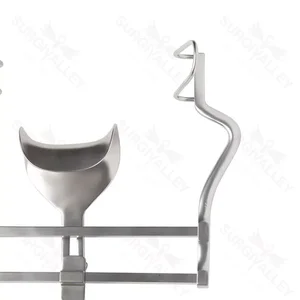
| Retractors | Handheld or self-retaining configuration, blade dimensions, spread, frame, joint and accessories | A system name used without listing included components |
| Rongeurs | Bite size and direction, shaft length, footplate or jaw profile, handle and cleaning access | “Same bite” assumed from a photograph |
Score evidence confidence separately from product preference
- Confirmed: supported by a current controlled source or an approved, traceable sample.
- Supplier-declared: stated in a quotation or response but the controlling source has not yet been supplied.
- Observed: measured or seen on a sample, with method and reviewer recorded.
- Inferred: assumed from a name, image or related product. Do not use as an acceptance fact.
- Unknown: no reliable information is available.
A comparison can be commercially attractive while still having low evidence confidence. Keeping the two scores separate makes that uncertainty visible.
Compare difference, consequence and action
For every variance, add three columns:
- Documented difference: the measurable or descriptive change.
- Requirement consequence: whether it affects a mandatory field, an accepted preference or an informational field.
- Required action: accept, reject, request evidence, obtain a sample or refer to an authorized clinical/technical reviewer.
This prevents a writer from inventing a performance consequence. If the effect is not established by approved evidence, the correct entry is “requires review,” not a confident prediction.
Control terminology and spelling
Choose one preferred family name for the worksheet, then record alternate names and eponyms as search aliases. Do not merge records solely because names are similar. Conversely, do not create duplicate lines just because punctuation, language or word order differs.
Keep regulatory and commercial conclusions in their proper lanes
A procurement comparison can document form, dimensions, mechanism, packaging and supplied evidence. It does not by itself establish regulatory clearance, conformity, interchangeability or suitability for a specific procedure. Those conclusions depend on the applicable market, manufacturer documentation and authorized review.
For U.S. research, the FDA provides public device databases including AccessGUDID and premarket records. Database presence and the meaning of each record should be interpreted in context; a search result is not a blanket endorsement. See the FDA medical device databases. For EU supply-chain responsibilities, consult the European Commission’s official economic operators guidance.
Publish a comparison that another reviewer can reproduce
The final table should include the source links or document references, access dates, measurement method, unresolved questions, reviewer and decision date. Update the record when a source changes. A concise table with visible unknowns is more useful than a polished narrative that hides uncertainty.
Continue with SurgiValley’s guides to writing instrument dimensions and configurations and comparing retractor families, or browse the catalogue by name or reference.
Related Posts
Oct 28, 2026 by Dr. Rachel Moore