
 English


Learn how clinical procurement teams can compare circumcision kits by instrument pattern, tissue-handling requirements, material documentation, compliance evidence, reprocessing needs and total ownership cost.
A circumcision kit clinical sourcing guide should do more than list clamps and forceps. Clinical teams need to connect instrument pattern, working-end geometry, material evidence, reprocessing requirements and documentation to the intended service environment. That approach helps buyers compare like with like while avoiding assumptions based only on a familiar product name or a supplier’s brief description.
The most reliable procurement process separates clinical requirements from supplier claims. Define the required instruments and configurations first, then request evidence for metallurgy, quality management, market documentation, cleaning instructions, sterilisation compatibility and inspection criteria. The result is a specification that supports clinical review, receiving inspection and longer-term replacement planning.
Clinical Requirements: Pattern and Tissue Handling
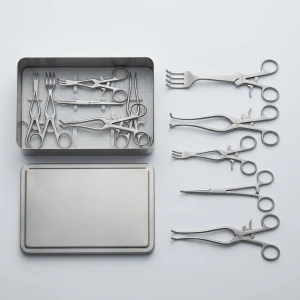
Start with the clinical team’s documented requirements rather than selecting a kit by title alone. A circumcision set may contain clamps, forceps, scissors, needle holders and auxiliary instruments, but the relevant pattern, size, jaw profile, working length and handle configuration should be confirmed for the intended service. Named patterns such as Mogen or Gomco should be treated as specification starting points, not complete technical descriptions.
Atraumatic handling is best addressed through review of the working end, edges, articulation, alignment, surface finish and movement. These characteristics should be assessed against the organisation’s clinical requirements by qualified users. Procurement teams should request drawings, catalogue references or representative samples where a name does not fully define the configuration.
- Document the intended clinical use and required instrument count.
- Record pattern, dimensions, working length and configuration for each item.
- Ask clinical users to review jaw alignment, edges, articulation and handling.
- Define acceptable substitutions before quotations are compared.
Metallurgy and Autoclave Longevity
Material selection should be documented at the instrument or product-family level rather than inferred from a generic reference to surgical stainless steel. Alloy designations such as 420 or 440A may appear in a specification, but the designation alone does not establish suitability for every clamp, forceps or cutting instrument. Ask the supplier to identify the material for each relevant component and to explain how heat treatment, hardness, finish and corrosion-control processes relate to the intended use.
Autoclave longevity is also a system question. Repeated exposure to moisture, chemicals, temperature, handling and incomplete drying can affect instrument condition. Buyers should therefore request validated or manufacturer-supplied reprocessing information, inspection criteria and maintenance limitations. A long service life should be treated as a claim requiring defined conditions and evidence, not as an automatic property of an alloy name.
- Request material designations and supporting documentation for each instrument family.
- Separate material claims from evidence about finish, heat treatment and corrosion control.
- Confirm compatibility with the facility’s approved cleaning and steam-sterilisation process.
- Define how pitting, staining, dull edges, misalignment and loose joints will be assessed.
Compliance and Reprocessing Verification
ISO 13485 and CE Class I should appear in a procurement review as verification topics, not as unchecked marketing language. Ask the supplier to identify the legal manufacturer, applicable product classification, conformity documentation, declarations, labelling and traceability information for the market where the kit will be used. The procurement file should record what was reviewed, which products it covered and whether the evidence matched the quoted configuration.
Reprocessing documentation deserves the same attention as quality and market documentation. Confirm whether the kit is reusable, supplied sterile or intended for processing before use, and ensure the instructions identify cleaning, inspection, packaging, sterilisation and storage expectations where applicable. Facility policies and validated processes remain controlling; supplier information should be reviewed by the responsible infection prevention, sterile processing and clinical teams.
| Verification area | Questions for the supplier | Receiving or review evidence |
|---|---|---|
| Quality system | What quality system applies to the manufacturer and the quoted products? | Current certificates or equivalent controlled documentation, with scope reviewed. |
| Market documentation | What classification and conformity documents apply in the destination market? | Product-specific declarations, labels and traceability records. |
| Material evidence | Which material and finish apply to each instrument? | Material statement, drawing, specification or controlled product record. |
| Reprocessing | What cleaning, inspection and sterilisation information is supplied? | Current instructions matched to the exact product and configuration. |
| Change control | How are material, design and supplier changes communicated? | Agreed notification process and revision-controlled documentation. |
Procurement Economics: Reusable or Single-Use
The reusable-versus-single-use decision should be based on the full operating model rather than purchase price alone. For reusable kits, include acquisition, instrument processing, inspection labour, packaging, repair, replacement, inventory and the cost of unavailable or incomplete sets. For single-use devices, include unit price, recurring purchasing, packaging waste, storage, stockout exposure and any supplier qualification work.
Container economics can materially affect the comparison. A complete kit may reduce picking effort and simplify allocation, but it can also include instruments that are rarely used or require replacement at different rates. Compare an itemised set against the actual procedure mix, tray capacity, processing workflow and minimum stock policy. Keep frequently replaced components identifiable so they can be replenished without unnecessarily replacing the entire set.
- Model acquisition and recurring costs over the organisation’s planning period.
- Include processing, inspection, repair, replacement, storage and waste.
- Compare complete kits with modular or itemised purchasing options.
- Test the effect of utilisation, stock levels and incomplete trays.
- Use the same clinical configuration when comparing reusable and single-use options.
RFQ Checklist for Circumcision Instrument Sets
A clear request for quotation reduces ambiguity and makes supplier responses easier to compare. State the intended use, required patterns, sizes, quantities, packaging expectations and destination market. Ask suppliers to identify every item by catalogue reference and to flag any substitution, optional component or variation between sample and production configuration.
Require evidence before approval rather than after delivery. A sample review can assess dimensions, working-end geometry, articulation, surface finish, markings, packaging and document consistency. Receiving controls should then verify the delivered set against the approved specification. This process does not replace clinical validation or regulatory review, but it creates a traceable link between the RFQ, the approved sample and the order.
- List every instrument, quantity, pattern, size and catalogue reference.
- Specify required material and finish documentation without prescribing unsupported claims.
- Request applicable quality, conformity, labelling and traceability records.
- Define sample approval, inspection, nonconformance and replacement procedures.
- State reprocessing documentation and packaging requirements.
- Record permitted substitutions and require approval for changes.
Build the Specification Before Comparing Prices
A dependable circumcision kit specification connects clinical pattern selection with documented material, reprocessing, compliance and lifecycle requirements. It should make clear which characteristics require clinical approval, which claims require supplier evidence and which conditions affect expected service life. This structure helps procurement teams compare reusable kits, modular sets and single-use alternatives on a consistent basis.
The practical next step is to create an itemised RFQ, circulate it for clinical and sterile-processing review, and require product-specific documentation before approving a supplier or bulk order. Keep the approved configuration, evidence and inspection criteria together so future replenishment decisions remain consistent.
Selected ENT and Maxillofacial products
Frequently asked questions
What should an RFQ include for a circumcision kit?
Include the intended use, instrument patterns, dimensions, working lengths, quantities, configurations, catalogue references, packaging expectations and destination market. Request material information, reprocessing instructions, traceability details, applicable conformity documentation and a clear statement of substitutions. Also define sample approval, receiving inspection, nonconformance handling and change-notification requirements before quotations are evaluated.
Does a 420 or 440A designation prove that an instrument will have long autoclave life?
No. An alloy designation is only one part of the assessment. Buyers should also review the instrument’s construction, heat treatment, finish, corrosion-control process, cleaning exposure, drying conditions, sterilisation cycle and inspection practices. Ask for product-specific documentation and evaluate representative samples under the facility’s approved workflow rather than treating a material label as a durability guarantee.
How should teams verify ISO 13485 or CE Class I claims?
Ask the supplier to identify the legal manufacturer, applicable products, destination market, classification basis and supporting documentation. Review whether certificates, declarations, labels and traceability records match the quoted instruments and configurations. Quality, regulatory, clinical and sterile-processing personnel should determine whether the evidence is sufficient for the organisation’s purchasing and market requirements.
When can a reusable kit be more suitable than a single-use option?
Suitability depends on the organisation’s procedure volume, processing capacity, inventory model, staffing, repair pathway and documentation requirements. Compare acquisition, processing, inspection, replacement, storage, waste and stockout costs using the same clinical configuration. A reusable option should also be compatible with validated local reprocessing and have a practical plan for inspection, maintenance and replenishment.
Related reading
- Autoclave and Passivation Protocols for Surgical Scissors
- 420 vs 440A Stainless Steel for Orthopedic Instruments
- Reusable vs Single-Use Surgical Instruments: A Total-Cost Decision Framework
- Surgical Instrument Documentation Checklist for US, EU and UK Buyers
Procedure Kit Procurement & Sterile Pack Options
Hospital procurement officers, clinical teams, and surgical leads can review engineering drawings, material test reports (ASTM F899 / ISO 13485:2016), and institutional quotation terms across the official Male Circumcision Procedure Packs & Clamps catalog.
Related Posts
Oct 28, 2026 by Dr. Rachel Moore